
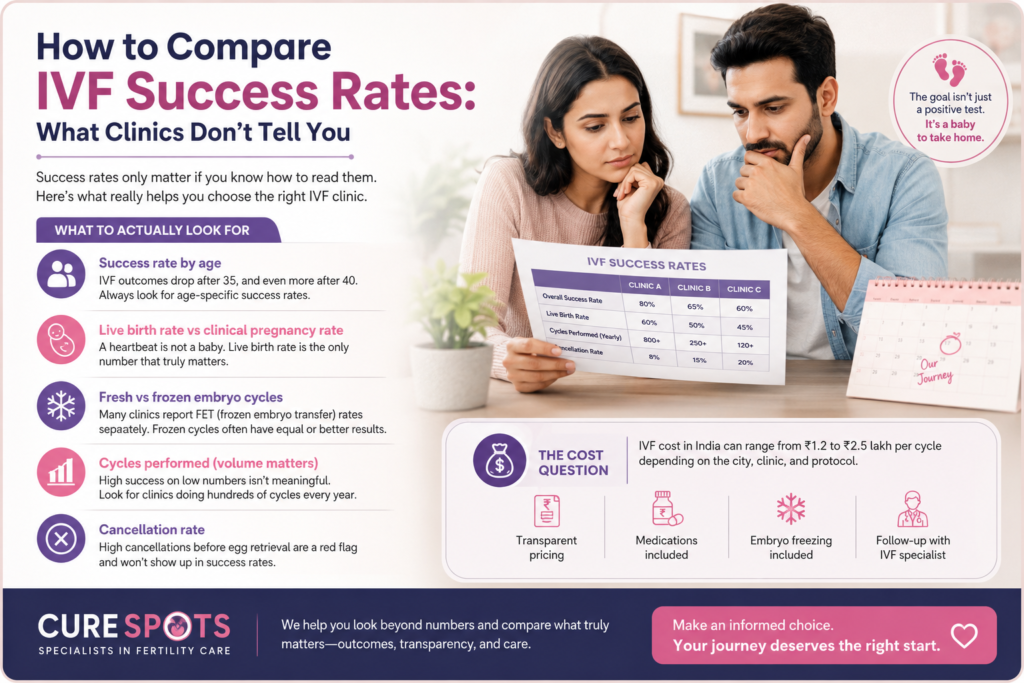
You might have begun the search for IVF and hit a brick wall of percentages already. All clinics lead with their success rate. Some say 60%. Some say 80%. Others do not bother to explain what those numbers even represent. And how are you sitting trying to make one of the most important decisions in your life using data that you know, but probably can’t trust. Now, the truth is that success rates do matter but only if you know how to read them.
Why the Numbers Don’t Always Tell the Full Story
A clinic with a high success rate may be selecting its best patients – the youngest, the simplest diagnoses, embryos with best grades. A clinic with slightly fewer patients might be accepting the most challenging cases that other clinics don’t want to handle. Neither number is wrong. But neither truly tells you what you need to know. The only thing that actually matters is whether that success rate applies to you.
What to Actually Look For
Here is what to look into while comparing clinics, irrespective of whether it is the IVF cost, doctor credentials or the outcomes:
- Success rate by age: IVF outcomes decrease considerably after 35, and even more so after 40. A clinic’s overall rate means little if that value is not specified according to age groups.
- Live birth rate versus clinical pregnancy rate: If there was a heartbeat detected, it counts as a clinical pregnancy. A live birth is a baby to take home. These do NOT represent the same number. Always inquire about delivery rates.
- Fresh vs frozen embryo cycles: Many clinics currently report FET rates apart. Results for frozen cycles tend to be equal or better – know the denominator you are dealing with.
- Cycles performed: A clinic can boast 90% success on 20 cycles, but this is not statistically sound. Volume matters. Seek clinics performing hundreds of cycles a year.
- Cancellation Rate: If a high percentage of cycles are cancelled prior to egg retrieval, this is cause for concern – and will not appear on the success rate at all.
The Cost Question
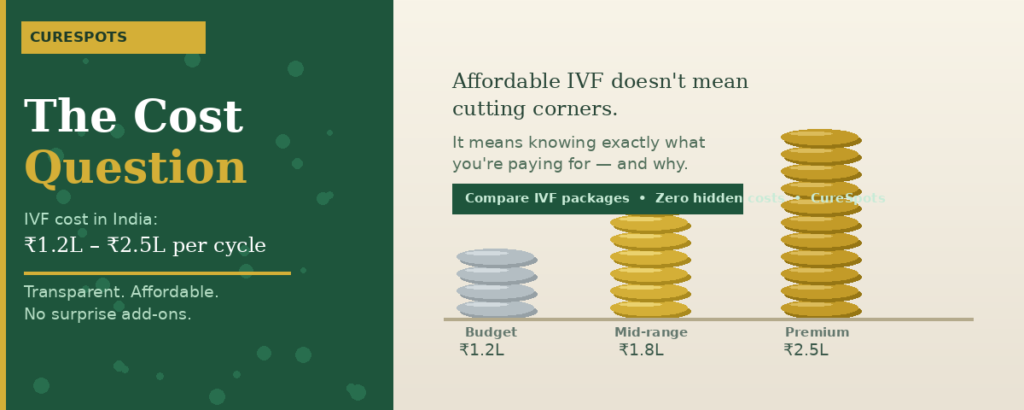
Whether the reasons should be well-planned or indefinite, IVF cost in India counter variances a lot – near with Rs.1.2 to 2.5 lakh per cycle depending upon the city, center and protocol included. Affordable IVF does not mean cheap IVF. Which means transparent pricing without additional costs midway through the treatment.
We at CureSpots, continue to help you compare not only on success rates but also what is really included in the package: medications, monitoring and embryo freezing as well as follow-up consultations with a qualified IVF doctor & fertility specialist. A cheaper-seeming sticker price that resulted in three failed cycles is more expensive than a slightly higher one done right the first time around.
How CureSpots Helps You Decide
And we know this is an emotionally and financially exhausting process – but we pull you through it. We do not merely list the best IVF clinics; we try to clarify why one would be more suitable for your case than another. Because the correct clinic for your friend is probably not the correct one for you.
FAQs
Q: What is a reasonable IVF success rate?
Strong live birth rates are greater than 40-45% per cycle for women aged less than 35. Expectations change above 35 – ask your fertility specialist for age-adjusted benchmarks.
Q: Higher IVF facility cost better success rates?
Not automatically. Have higher priorities than price, such as live birth rates, doctor experience and lab quality.
Q: Can an individual have unlimited IVF cycles?
Most patients need 2–3 cycles. An appropriate estimation, according to your condition must be put forth by your IVF doctor.
Q: Is IVF cost in India comparatively cheaper as compared to abroad?
Yes – considerably. India is a real option for medical travelers as it offers internationally comparable treatment at merely 20% of the cost that of in US, UK or Europe.