
For you, fresh off your most recent IVF cycle, you’ll know that the two-week wait is arguably one of the hardest parts of your entire path. You know if you have poured so much money into it (and time, and physical effort, and emotional expense). At CureSpots we’ve walked with thousands of patients through exactly this moment, and we want to bring you clear answers straight up as you’re not searching for answers at 2 AM.
Timeline for IVF After Transfer
Your body has to do its own job after your embryo transfer. The confirmation window broadly looks like below:
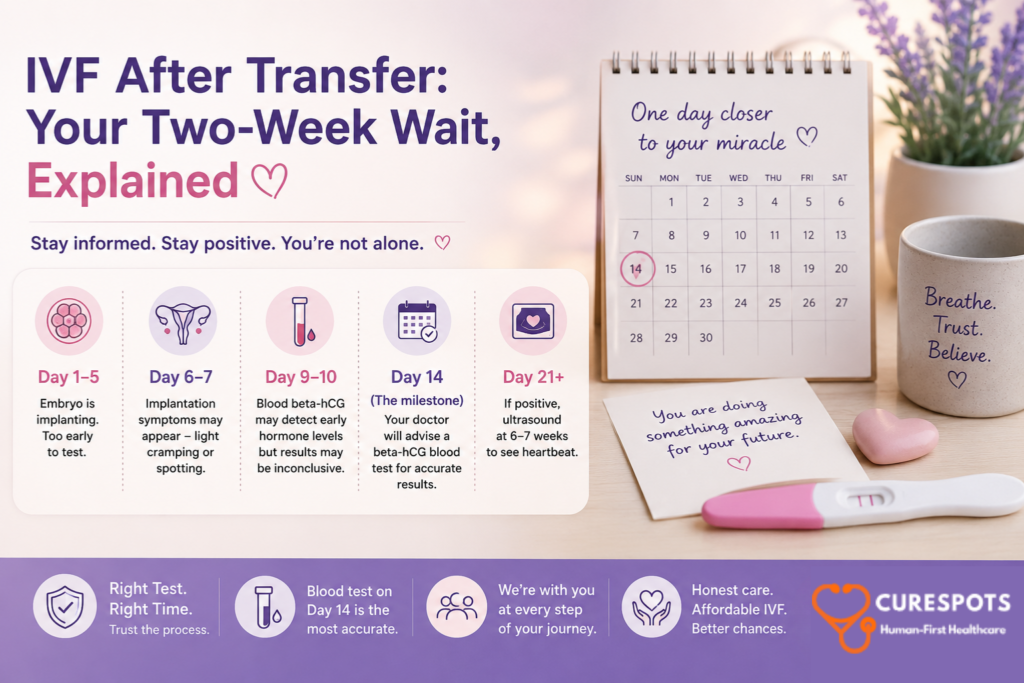
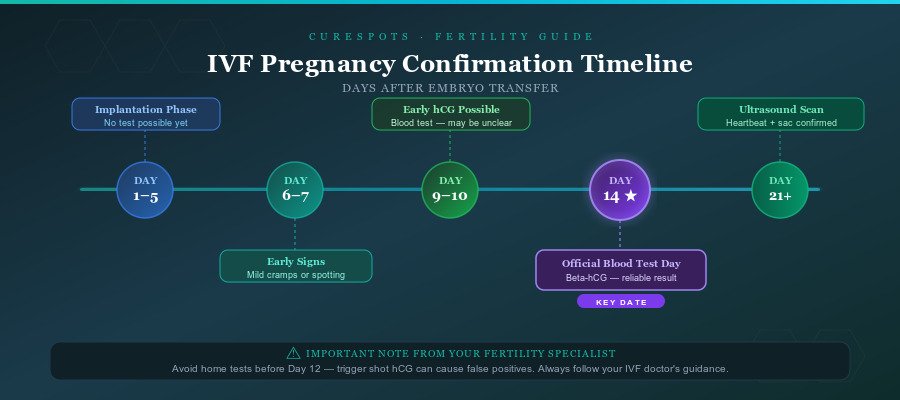
- Day 1-5 after transfer: The embryo is trying to implant into the uterine wall. So he will get no test results for some time.
- Day 6-7: The earliest some patients notice implantation symptoms – light cramping or mild spotting. These are all normal and do not merit despair.
- Day 9-10: At this point, a blood beta-hCG test may be able to detect early hormone levels but the results will often be inconclusive.
- Day 14 (the two-week milestone): This is when your reproductive endocrinologist would encourage you to undergo a beta-hCG blood test for an accurate answer.
- Day 21+: If the blood test is positive, an ultrasound is generally arranged at week 6–7 (by now a gestational sac and heartbeat can be visualized).
Why We Do Not Test Too Early
We understand the urge. However, if you test before day 12-14 and may get a false negative or possibly even a misleading positive due to the hCG trigger shot still present in your system. Your IVF doctor will tell you the exact date depending on your protocol. Home pregnancy tests also have lower sensitivity than blood tests and may lead to unnecessary anguish. Wait for the blood test. It’s worth it.
Next Steps after a Positive Result
Here is what you should keep in mind: a successful pregnancy after IVF is not the finish line, it simply marks the beginning of the next leg of your journey. Your care team will check hCG levels every 48 hours to make sure they are doubling appropriately. We should not take a positive number by itself — it is the trend that matters. Following an appropriate hCG confirmation, early ultrasound is performed to confirm location (excluding ectopic pregnancy) and viability.
But What If It Turns Up Negative
No one wants to talk about this, but it is an important enough topic to warrant some space. An IVF resulting in a negative result does not imply the end of the road. More than one cycle is needed for most couples. CureSpots takes the hassle out of finding the best IVF clinic by connecting you with honest options and affordable IVF, so that cost never becomes a reason for giving up. IVF cost in India is much cheaper price than a majority of the world, and at CureSpots costs are designed around how many chances you can afford to have through without money stress. We see a fertility specialist who explains what happened and what can be done next; frozen embryo transfer, protocol change or further diagnostic tests.
FAQs
Q: When should you use a home pregnancy test after IVF?
You can, but it’s not advised before day 12-14. Often the trigger shot causes false positives so early testing creates a lot of anxiety for no reason. IVF doctor will schedule one blood test at the right time.
Q: When are beta-hCG blood tests done after IVF?
Highly accurate when performed at the optimal time-day 14 after transfer. It can detect pregnancy hormones much earlier and more accurately than a home test.
Q: What is the cost of IVF in India at CureSpots?
We provide the best IVF packages which are reasonable with no hidden cost through CureSpots. Actual figures for IVF cost rely in your treatment protocol – contact us for a customized estimate.
Q: How many IVF cycles does it take before pregnancy?
This is dependent on age and diagnosis, as well as embryo quality. The majority of patients are successful within one to three cycles. As each fertility situation is unique in its needs, our fertility specialists will review every case on an individual basis and recommend the most effective route forward.