

When you’re going through fertility treatment, starting IVF is like learning a new language. You are already carrying so much hope and worry at once. You do not have to be a scientist to understand your treatment, you deserve someone explaining it in an easy manner. At CureSpots, we want each patient who walks into an embryology lab to feel educated not frightened before they go in for their treatment – this article is our way of helping you with that.
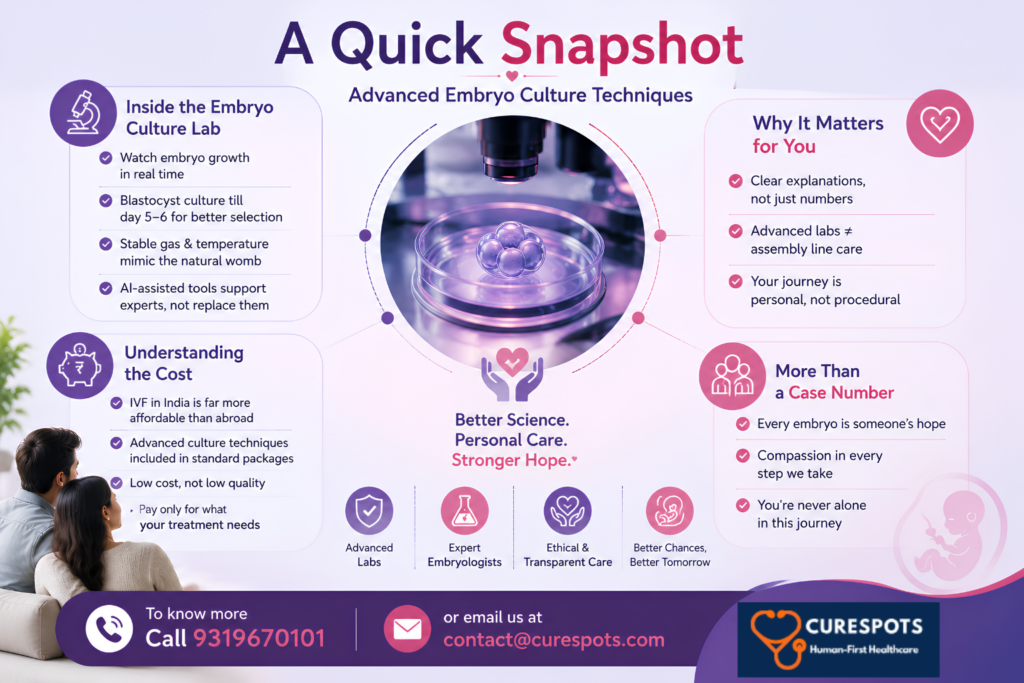
Inside the Embryo Culture Lab
Embryologists grow embryos in a specialized lab for the first few days after fertilization before transferring them. More recent advancements in culture techniques have quietly but dramatically changed the whole picture and provided embryos with a better environment to grow as well as clearer data for your fertility doctor to guide your treatment decisions.
- Embryologists would be able to watch embryo development in real time, continually observing the embryos without having to disturb it by taking them out of their incubator.
- Blastocysts culture extends growth to day five or six, allowing the identification of embryos with the strongest potential
- Compared with older lab setups, controlled gas and temperature incubators more closely replicate the body’s natural environment
- AI-assisted grading tools now more commonly allowed into embryology in addition to human experience providing an additional layer of insight without the removal of human judgment.
We do not about perfection in any of this. It is about the best available chance for your embryos, and you, at each step.
Why This is Important for Your Peace of Mind
We know that behind every lab term is someone holding their breath with the phone next to them. This is why your embryologists take time to explain what they are seeing in your case, rather than just passing you off with a report of numbers. The best IVF clinic can provide the appropriate equipment, but it’s all about if they treat your journey as personal or procedural.
Understanding the Cost
We know that cost plays a far bigger part in this decision – and we will not pretend otherwise.
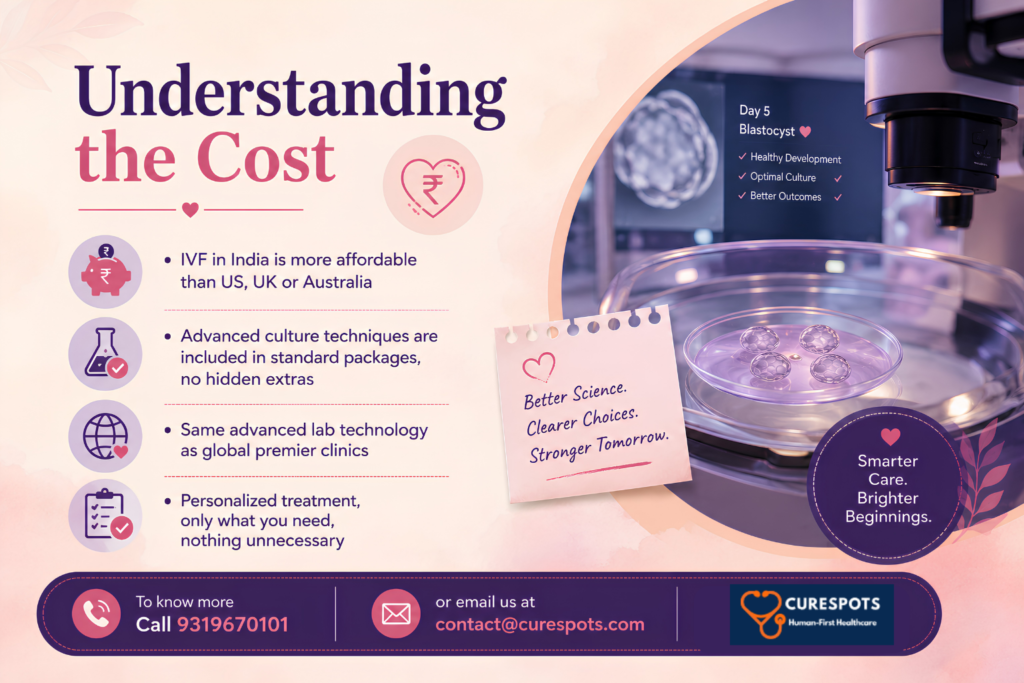
- IVF cost in India is still much less as compared to US, UK or Australia without compromising lab quality
- Here, advanced culture techniques generally are a part of standard IVF cost packages and are not charged as hidden extras
- Affordable IVF does not mean low quality, a majority of Indian clinics use the same laboratory technology as found in premier global institutions
- With IVF, every treatment plan is designed for your particular case by an expert IVF doctor, meaning you never pay for procedures that are unnecessary.
Each of those embryos represent somebody’s hope in that lab. You bring that awareness and it drives every decision our team makes, but we want you to feel the care with every conversation you have with us.
FAQs
Q: What is blastocyst culture in IVF?
Embryologists culture embryos in the laboratory for five to six days before transferring them, allowing them to select the strongest embryos.
Q: Is it better to culture embryos longer in IVF?
Improved results can be achieved by selecting and monitoring embryos. But ultimately success is still dependent on individual factors such as age or egg quality.
Q: Does advanced embryo culture cost more than standard IVF?
In Indian clinics, it is part of standard packages rather than billed separately, which has kept affordable IVF truly affordable.
Q: How can I know if my clinic uses time-lapse imaging?
Very easy, just ask your fertility specialist directly; a transparent clinic will explain to you their lab technology and process.